
One of the parts of my work I value most is accompanying leaders who carry real pressure: difficult conversations, competing demands, and decisions that cannot wait until everyone has calmed down. In those moments, emotion is useful information. It becomes a problem when it chooses the behaviour for us. A rule I use, and often share with clients, is this: an emotion gets a vote, not the decision.
A pattern I hear very often is this one:
“I knew I shouldn’t reply straight away. I was angry, frustrated, hurt. But in the moment, I felt I had to do something. So, I reacted. Afterwards, I knew I could have handled it differently.”
From a systemic perspective, reactions do not stay ours. Once a reaction leaves us, it enters a relationship, and the relationship starts to organise itself around it. A very common loop looks like this:
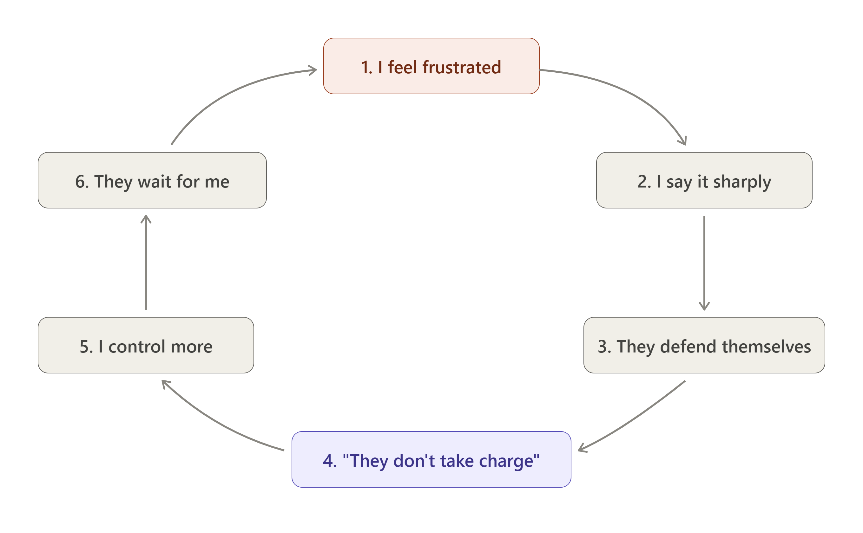
Two things hold this loop in place, and neither of them is the emotion. The first is how we explain the other person’s defensiveness: by their character, rather than by our own sharpness a moment earlier. The second is where each of us starts the story. Both people experience their own move as a reasonable answer to the other’s. Both are right about the part they can see. Neither sees the loop.
The good news is simple: a loop does not need everyone to change. It needs one move to be different.
That is why I developed HOLD–STILL–ACT™, a short sequence for the seconds and minutes before you respond. I have used versions of it for years in coaching, leadership programmes and work with teams, especially where the cost of one badly timed message is high.
1. HOLD — contain, without hiding
HOLD is not “don’t feel it” and not “don’t show it”. It is holding two things at once: not turning what you feel into a move against the other person, and not pretending it isn’t there.
In practice this often means saying something small and true instead: “I’m reacting to this. Give me a moment”. That is not discharge, because nothing is being aimed at anyone. It is not suppression, because nothing is being hidden. And it buys you the only thing you need right now, which is time.
The question: can I stay with this without making it the other person’s problem to absorb?
2. STILL — create space, and use it well
Still is not passive, avoidant or indecisive. But it can go wrong.
If you spend the pause replaying what they said and rehearsing what you should have said, that is rumination, and it makes anger grow rather than settle. A pause spent building your case is worse than no pause at all.
STILL works when your attention moves off the content and onto the shape of the interaction:
- What am I reacting to?
- What pattern am I in?
- What would I be reinforcing?
- What would a different move make possible?
If you notice yourself preparing arguments, you are ruminating, not being still. Move gently, walk calmly, do something absorbing, and come back to the pattern question. And give it longer than feels necessary. Strong activation does not fade in ninety seconds.
The question: what becomes visible when I stop trying to resolve this immediately?
3. ACT — move from clarity, not certainty
Not because the emotion has gone, and not because you are sure. Because you can now see enough to choose.
Agency here does not mean acting outside the system. It means knowing that your move becomes part of it, and choosing it with some sense of what it will reinforce, interrupt or shift.
The question: given what I can now see, what is the most useful next move?
The sequence:
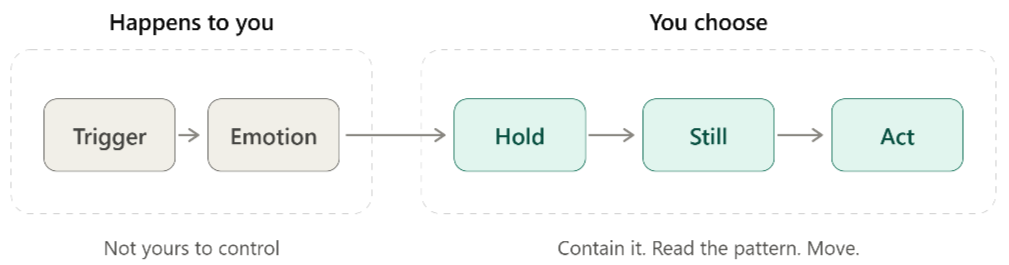
Contain it, don’t discharge it. Make space, read the pattern. Choose, and move.
The four traps (and how the sequence blocks them):
- Discharge dressed as authenticity: “I’m just being honest”. HOLD separates being honest from taking aim.
- Suppression dressed as professionalism: nothing shows, everything stays. The small true sentence keeps the feeling in the room without weaponising it.
- Rumination dressed as reflection: rehearsing the argument. STILL redirects attention from the content to the pattern.
- Delay dressed as composure: waiting until it goes away and the conversation never happens. ACT is the step that closes the sequence. Without it, this is avoidance with a nicer name.
What it is designed to support
For the person:
- Fewer decisions taken at peak activation
- More choice about how and when something gets said
- Emotion treated as information, not as an instruction
- Less regret after difficult exchanges
For the leader:
- Fewer escalations that started with one sharp message
- More deliberate use of authority
- The habit of asking what a response will reinforce, before making it
- Difficult things still get said, just on purpose
For the organisation:
- Conflicts that get worked rather than repeated
- Less rework created by decisions made while activated
- A shared language for the moment before a response
When to use HOLD–STILL–ACT™
- Something has landed hard and you can feel the urge to respond now
- You are about to send a message you would not send tomorrow
- The same argument keeps coming back with different words
- You hold authority, and your reaction will travel further than you intend
When not to use it
If your pattern is already avoidance, this is probably the wrong medicine. For someone who delays difficult conversations and calls it composure, “hold and be still” is a licence, not an intervention. Your correction is the opposite: shorten the distance between what you feel and what you say. Which move helps depends on the pattern you are in.
Where someone is being harmed, delay is not neutral. Harassment, discrimination, safeguarding and safety need an immediate response. “I was making space” is not an account of one.
HOLD is for you, not for others. Asking the person with less power to hold their emotion so that the room stays comfortable is not systemic practice. It is a discipline you take on yourself, not an instruction you pass downwards.
What it draws on
Four ideas, in plain words:
- Hiding a feeling that is already running does not make it smaller. It stays, the body stays activated, and the conversation gets harder for both people.
- Venting does not empty anger. What reliably lowers anger is lowering arousal: slow breathing, calm movement, stillness. Not hitting things, and not going for a hard run.
- Attention can be turned onto the experience itself. That is what makes “I am having an angry thought” possible, instead of simply being angry.
- In a relationship, behaviour is circular. Each person sees their own move as a reply to the other’s, and the attempted fix often keeps the problem alive.
The first three come from research on emotion regulation, anger and mindfulness. The fourth comes from systemic practice. HOLD–STILL–ACT™ puts them into one sequence, and this sequence itself is my practice, not a tested intervention.
An invitation for you
You do not need to become calmer to lead better. You need a little more space between what you feel and what you do with it.
I invite you to try HOLD–STILL–ACT™ for two weeks, on one recurring situation: the colleague who triggers you, those client emails, the meeting you always leave irritated. Don’t try to remove the emotion. Contain it. Don’t rush to fix the situation. Make space, and look at the pattern. Then, when you can see enough to choose: act.
Five reflective questions
- In which situations does your emotion become behaviour fastest?
- Which emotions are hardest for you to hold without aiming them at someone?
- What actually makes you still, rather than just postponing the reaction while you rehearse it?
- Which pattern might your usual response be quietly reinforcing?
- Is there a relationship where your problem is that you hold too much?
#HoldStillAct #SystemicLeadership #ExecutiveCoaching #SystemicCoaching #Agency #LeadershipDevelopment
Citation & Attribution
Escartín, J. (2026, [Month Day]). From reaction to agency with HOLD–STILL–ACT™: A practical tool for the moment between feeling something and doing something about it. https://jordiescartin.com/en/blog/
Please keep the author credit visible in adapted versions.
© 2026 Jordi Escartín. HOLD–STILL–ACT™ is an unregistered trade mark used by Jordi Escartín.