
A practical tool for turning beliefs into testable hypotheses and, sometimes, into personal theories.
One aspect of my work that I value most is supporting leaders who carry real complexity: competing stakeholder demands, high ambiguity, and decisions that must be made before the data feels “complete”. In those environments, confidence is useful, but it can also become a liability when confidence is mistaken for evidence.
A pattern I see frequently sounds like this:
“I’m making decisions quickly all day. Afterwards, I replay them in my head: Was I right, or just persuasive? The team debates opinions, not facts. We “feel” what’s true, and then we defend it. And the same issues keep coming back, just with new labels”.
From a systemic perspective, beliefs don’t stay neutral. Once a belief is stated, especially by someone senior, it shapes attention: people notice confirming signals, ignore disconfirming ones, and build narratives that protect the original assumption. The result is a reinforcing loop: belief → selective evidence → increased certainty → reduced testing → repeated mistakes. The good news is simple: if we can make the loop visible, we can interrupt it.
This is why I developed EvidenceLoom™: The Decision Evidence Ledger, a lightweight, repeatable way to convert assumptions into testable hypotheses, track evidence quality, and make decisions with less noise and more learning. I’ve used variants of this approach for years in coaching, leadership labs, and team interventions, especially when the “truth” is contested.
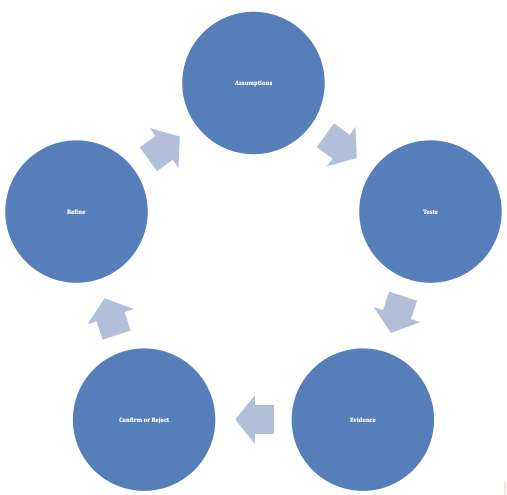
That is the core of the tool below, which can also be represented as a learning loop (circular model):
Three definitions to start with
A practical tool needs clean definitions, otherwise we end up debating words rather than reality.
- Hypothesis (testable claim): a claim you can evaluate by observing the world. It implies what you would expect to see if it were true (and ideally what you would expect to see if it were false).
- Facts (observations / data): what happened (or what was reliably measured). Facts are not interpretations, motives, or forecasts.
- Theory (well-supported explanatory model): a coherent explanation that has survived testing, accounts for the evidence better than alternatives, and remains open to refinement. In personal development, I call this a personal theory: a working model supported by evidence and still revisable.
A rule I use (and often give clients) is simple: Any belief that matters gets downgraded to a hypothesis until it earns promotion. Promotion happens through accumulated, high-quality evidence and tests that could have disproved the belief but did not.
The simplest version (single-sheet, fast adoption)
The easiest way to use EvidenceLoom™ is an Excel spreadsheet like the one shown below. This structure is inspired by cognitive restructuring “thought records”. EvidenceLoom™ extends them by requiring predictions, disconfirming tests, and iterative upgrading from hypothesis to a provisional personal theory. This is the “minimum viable” EvidenceLoom™, ideal for teams that want speed and low friction.

- Belief (Hypothesis): what you think is true
- Prediction: what you would expect to observe if it were true
- Evidence (Confirm): observable facts that support the hypothesis
- Evidence (Reject): observable facts that contradict the hypothesis
- Test (if needed): what you will do to check it (only if evidence is insufficient or low quality)
- Evidence quality: High / Medium / Low
- Weight: 0–3
- Decision update: keep / revise / discard
A guiding principle here is worth stating explicitly: If we don’t have a prediction and a test, we’re not debating reality, we’re debating identity.
How to fill the ledger (step-by-step)
Most people overcomplicate this. The discipline is not sophistication, it is honesty and repeatability.
- State the belief without granting it truth (Belief / Hypothesis). Write it as a claim to be tested (e.g., “My boss doesn’t like me”, “I’m not good at that”).
- Define what would be true if it were true (Prediction). Specify what you would expect to observe if the belief were true (and ideally what you would expect to observe if it were false).
- Record supporting facts (Evidence – Confirm). List only observable facts/data that reliably point toward the belief being true (not interpretations).
- Record contradicting facts (Evidence – Reject). List observable facts/data that point against the belief (again: facts/data, not motives or narratives).
- Decide whether a new check is needed (Test, if needed). Only add a test if evidence is insufficient, mixed, or low quality. A good test is not “look for supportive evidence”. It asks: What would I see if this were true, and what would I see if it were not true? Keep tests small, time-bound, and observable.
- Rate the strength of what you have (Evidence quality). Rate the overall evidence quality as High / Medium / Low (source reliability, directness, and potential bias).
- Assign influence (Weight). Assign a 0–3 weight to reflect how strongly the evidence should influence the decision right now.
- Update your stance (Decision update). Based on the balance of confirm vs reject evidence (and any test results), choose keep / revise / discard. Include a short “because…” rationale if helpful (one sentence).
Updating vs upgrading: what should happen at the end?
EvidenceLoom™ is not about “proving yourself right”. It is about deciding what becomes your working model.
- Updating the hypothesis means revising, weakening, or discarding a belief because the evidence doesn’t support it.
- Upgrading to a personal theory happens when repeated, high-quality evidence across contexts supports a better, more reliable model (still provisional, but meaningfully grounded).
What to do with a new personal theory (so it changes behaviour, not just language)
If the tool ends as an “insight”, it will fade. If it ends as a practice, it reshapes decisions.
- Replace the old assumption with the upgraded one. Write the new personal theory as a single sentence and keep it visible.
- Use the old belief as a trigger. Label it “old hypothesis”, then recall the strongest facts supporting the new model.
- Return to facts before interpretation. Ask: What did I observe? What else could explain it? What evidence do I have on both sides today?
- Run a 60-second loop when activated. One observed fact, one alternative explanation, one small test you can run.
- Clarify directly when appropriate. Use a simple, non-accusatory question focused on observable behaviour and impact.
- Keep updating. Personal theories are provisional; if new high-quality evidence accumulates against them, revise again.
Common failure modes (and how the ledger prevents them)
This is where the tool becomes quietly powerful: it blocks predictable cognitive traps.
- Confirmation bias: the ledger forces an “against” column and disconfirming tests.
- Vague claims: it requires predictions and observable measures.
- Interpretations treated as facts: it keeps returning you to observable data.
- Over-upgrading too early: it encourages accumulation across contexts and time, not “one win → certainty”.
Benefits
For the team member
- Shifts debate from opinions to hypotheses.
- Builds critical thinking without personal defensiveness.
- Improves clarity on “what would change my mind”.
- Develops judgment about evidence quality (not just evidence volume).
- Increases ownership and follow-through.
For the leader
- Reduces circular discussions and “strong opinions, loosely held” theatre.
- Improves decision traceability (why we decided, based on what).
- Creates a learning loop: decisions become data.
- Helps detect bias early (authority bias, confirmation bias, sunk cost).
- Protects focus and time: fewer debates, more progress.
For the organization
- Stronger execution under uncertainty.
- Better cross-team alignment (shared criteria for “what counts”).
- Less rework and fewer recurring problems.
- Faster learning cycles and improved innovation hygiene.
- More mature culture: inquiry over blame.
When to use EvidenceLoom™
Use the ledger when:
- A belief is driving decisions, anxiety, avoidance, or conflict.
- You feel certain but cannot point to robust evidence.
- You need a grounded way to decide what is “true enough” to act on.
- You want to replace self-narratives with a learning loop.
One invitation for you
If you lead in complexity, you don’t need perfect information, you need a disciplined way to learn faster than the problem evolves. I invite you to test EvidenceLoom™ for two weeks with one recurring decision type (hiring, prioritization, customer complaints, operational incidents). Let the ledger do what meetings often cannot: separate conviction from evidence and convert debate into learning.
Five reflective questions
- Where in your work do strong beliefs travel faster than strong evidence?
- What is one assumption your team repeatedly treats as “obvious”, without testing?
- When was the last time you changed your mind because of new data (not new arguments)?
- What would improve if every decision had a “prediction + review date”?
- How would your culture shift if “What would change your mind?” became a standard question?
#EvidenceLoom #DecisionMaking #CriticalThinking #SystemsThinking #SystemicLeadership
Citation & Attribution
Escartín, J. (2025, April 23). From Certainty to Clarity with EvidenceLoom™: The Decision Evidence Ledger for Leaders & Teams. https://jordiescartin.com/en/blog/.
Please keep author credit visible on adapted versions.
© 2025 Jordi Escartin. EvidenceLoom™ is an unregistered trademark used by Jordi Escartin.