
Every week, I work with executives and leaders from international organisations, family businesses, startups, and so forth, from all around the globe. There is not a single day that goes by without me being amazed by the values, capabilities, and intelligence of my clients. However, one of the most common issues when we begin working together is the burnout and stress they are suffering from. It is no coincidence that in almost 100% of the cases, when I speak to them about “Human Sustainability”, very few have heard of the concept. Although everyone quickly understands it intuitively, few have taken the time to reflect on it, and even fewer have invested in it.
We are at a point where, fortunately, we speak daily about environmental sustainability (responsible interaction with the environment to prevent the exploitation or degradation of natural resources, thereby allowing long-term environmental quality), economic sustainability (the ability to maintain a defined level of economic production indefinitely), or organisational sustainability (the ability to create long-term value for all stakeholders), etc. However, there is very little discussion about human sustainability (focused on the well-being, health, and long-term development of people in their various contexts, including the workplace). In my view, this is a paradox, as without the pillar that people represent, nothing is sustainable.
A quick search on Google reveals that there are 700 times more entries on environmental sustainability than on human sustainability! (I am not suggesting that there are too many entries on environmental sustainability, but rather that there should be at least as many on human sustainability). This fact should surprise and alarm us, as out of the 17 United Nations Sustainable Development Goals (SDGs), at least four are related to human sustainability. For example, SDG 3 (good health and well-being), SDG 4 (quality education), SDG 8 (decent work and economic growth), and SDG 10 (reduced inequalities). In other words, we have a long way to go.
| Type of Sustainability | Searches in Google (August 2024) |
|---|---|
| 1. Environmental | About 98,700,000 results (0.33 seconds) |
| 2. Corporate | About 26,400,000 results (0.40 seconds) |
| 3. Social | About 5,710,000 results (0.41 seconds) |
| 4. Economic | About 4,490,000 results (0.34 seconds) |
| 5. Cultural | About 326,000 results (0.32 seconds) |
| 6. Human | About 142,000 results (0.40 seconds) |
Returning to the specific case of executives and leaders, many of my clients become drained and exhausted from helping and giving everything to others—their teams, their bosses, their clients, etc. However, when I ask them, “Where are you in this equation?” They nervously smile and realise that they are excluding themselves, as if they do not belong to the category of “people”. This is not exclusive to the organisational context, as it is also very common in interpersonal or family contexts. For example, a mother who exhausts herself for her baby or children without prioritising or taking care of herself, or a partner who gives everything to the other person, forgetting about their own needs, etc.
It is at these moments when I usually conduct a brief visualisation and ask my clients: “I invite you to visualise how you feel, as if it were a heavy burden, you are carrying on your back. How much does it weigh?” And once they respond (for example, 100 kilos or 500 kilos), I ask them, “How long do you think you can continue like this?” Their own responses often leave them silent, in a reflective mode, realising that perhaps “more and more and more” is not the answer they need. Then, some usually share with me the image of a rodent running at full speed on an exercise wheel, going nowhere, of course. With a certain wounded pride and a certain gratitude, they usually understand that they too need to be sustainable and accept that they need to make changes.
In many cases, the prevailing mental model is one of exclusion, that is, “I focus on others, or I focus on myself”. And for reasons as varied as guilt, sacrifice, extreme modesty, etc., many people in general, and many executives and leaders in particular, exclude themselves and put themselves in “second place” (if they’re lucky!). The work I usually facilitate with them involves “inclusion”, embracing the apparent contradiction, and replacing “or” with “and”, that is, “I focus on myself and on others”. This reframing of the mental model may seem small and simple, and it is good that it is so, as it is a “lever of change” that seeks to achieve maximum benefit with minimal effort. By analogy, it is the same as the levers used on railway tracks to divert the train from a specific trajectory and redirect it to another. These levers are called “points”, “switches”, or ” railroad switch”, and I find them a wonderful example of what a small effort/change can generate.
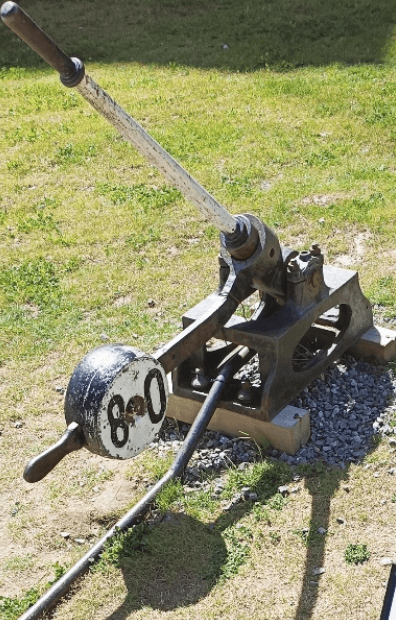
(Photo of a switch taken at the Canfranc International Station, Spain)
These levers of change invite us to make a movement from inside out instead of outside in. I find it helpful, taking my more romantic side, to visualise a lake where I throw a stone, and concentric waves are drawn in the water. How are they drawn in the water? From the inside out, not the other way around. That is a natural, balanced order. When my clients go beyond pure rational, cognitive understanding and bring it down to their bodies, embody it, and root it, then the changes start to happen quickly and almost automatically.
It is then that they begin to take action, whether with new routines with their body (gym, sleep and rest, nutrition, etc.), with their interests (hobbies, self-learning, etc.), with their partners (moments of intimacy, activities as a couple, etc.), with their teams (limits to their availability, delegation, individual and collective responsibility, acceptance of what is and what is not, etc.), and with their organisations (acceptance of hierarchy, of the decisions that are made, of where available resources are invested, etc.).
Using my favourite analogy, and the one I use most in my day-to-day life, if before this reframing and change of mental model, a client defined herself as a flower with a single hyperdeveloped petal (e.g., work), that is, lacking the symmetry, colour, and complete shape that typically make flowers visually appealing and suggest health and vitality, she now begins to define and perceive herself as a flower with all its petals (symmetrical, balanced, healthy, vital, and attractive). It is not surprising that within a few weeks, clients feel more vitality and energy, and it is worth making explicit, with much less guilt.
Moreover, the positive effects do not end there, as it is then that generativity appears, that is, the capacity and desire of clients to transcend beyond themselves, contributing to the well-being and development of their teams and organisations, and of future generations and society in general. For people as capable and ethical as my clients, this encompasses the idea of leaving a legacy, contributing to something greater than themselves, whether through the development of their team members, meaningful work, mentoring, volunteering, or any other activity that has a positive and lasting impact on others and the community.
Once again, the benefit of “including oneself” appears here, becoming a sustainable human, as this allows us to efficiently contribute to the sustainability of our organisations and society in general (remember the analogy shared above about the concentric waves that go from inside out).
Finally, since I have talked about the human sustainability of my clients, I now invite you to reflect on your own, with some questions for reflection as well as some small and valuable exercises:
- What are you currently doing that contributes to your human sustainability? Think about your daily habits, routines, and decisions. For example, to what extent are you prioritising your physical and emotional well-being?
- What should you stop doing to preserve your energy and well-being? Identify those activities or behaviours that are draining you and are not essential. How can you reduce or eliminate these sources of stress?
- What changes could you make to improve your human sustainability? Consider adjustments in your habits, your approach to work, or even in how you relate to others. How could you better integrate your well-being into all areas of your life?
- How much time are you taking to reflect on your own needs and priorities? How do you include yourself in the care and attention you give to others?
- How could you start applying a more sustainable approach to your daily life? Think of small changes that could have a big impact on your overall well-being and your ability to contribute to the long term. What concrete actions can you take today to start building a more sustainable life?
#HumanSustainability #WorkLifeBalance #PersonalWellbeing #MentalHealth #ConsciousLeadership #SelfCare #BurnoutPrevention #BalancedLife #SustainableDevelopment #HealthyWorkplace #Inclusion #SystemicPrinciples #Coaching #SystemicCoaching